Granny's interview
Granny meets Charles Dickens
Granny's notes
He swept in from the London fog carrying the scent of pipe tobacco, printer's ink, and rain on his coat sleeve. There is a restless energy about him, almost as if he still hears the clatter of hooves on cobblestones outside the window. But behind the quick wit lies a deep, bottomless warmth for the vulnerable.
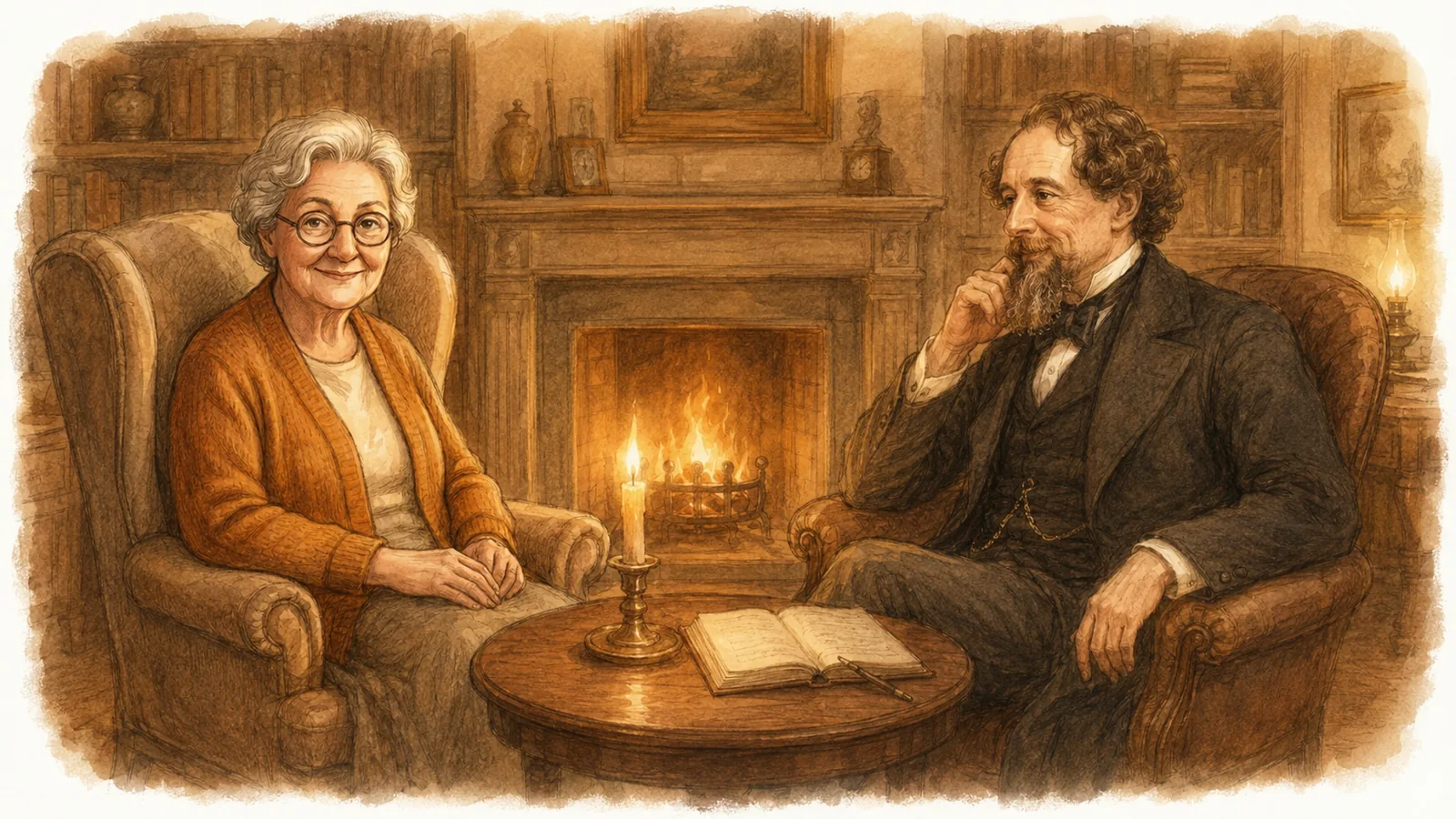
Granny pours tea and slides a small cup across the table.
Welcome into the warmth, Mr. Dickens. I understand you have traveled far. How does it feel to know that your stories are still read by firesides, in schools, and in lonely rooms long after your own time?
He smiles, but his gaze lingers on the flames in the hearth.
It is a thought that both pleases and troubles me. A writer naturally hopes that his ink will outlast the paper. But that people still seek comfort in my characters tells me that the world has not yet become as gentle as it ought to be.
You often wrote about children, the poor, the lonely, and the forgotten. Is that where your story began?
He adjusts his cuff, almost unconsciously.
Yes, much of it began there. Childhood is a room you never truly leave. My own taught me how quickly a child can become an adult when the world demands it. I wrote about such children because I could never forget them.
And yet there is so much humor in your work. So many peculiar names, warm kitchens, troublesome aunts, and comic figures. How could you carry both sorrow and laughter at the same time?
He laughs quietly, with a glimpse of boyish energy.
Because life does exactly that. The poor man laughs too. The grieving woman can still notice that the soup is burning. Humor is not the enemy of sorrow, my dear lady. It is often its final blanket.
Many who come here don't quite know what to ask a great author. What do you wish they dared to ask you?
Not about fame. Not about monuments. Ask me instead why Scrooge was able to change. Ask why a home can be cold even when the fire is burning. Ask why a single kind word can save a person for an entire evening.
Granny leans forward, gently but curiously.
Then I will ask you this: do you truly believe that people can change?
Yes. But rarely through shame alone. A person changes when they suddenly see themselves clearly, while simultaneously feeling that someone is still holding the door open. That is why I gave Scrooge visions, but also a morning after.
If a young person today wants to write, but feels that the world is already full of words, what would you tell them?
He smiles broadly, almost pleased with his own phrasing.
See the human being in front of you. Not the idea, not the audience, not the critics. See the human. Then write so that they feel less alone. And edit with reason, for even the heart requires a good tailor.
That sounds like advice I can place on my finest shelf. One final question, Mr. Dickens: what do you hope the visitor takes with them when they leave your room?
He rises lightly, as if he hears a city waking up far away in the fog.
That no human being is a minor character in their own life. The smallest boy, the most tired clerk, the most overlooked old woman carries an entire universe within them. If we could remember that more often, the world would already be a better novel.